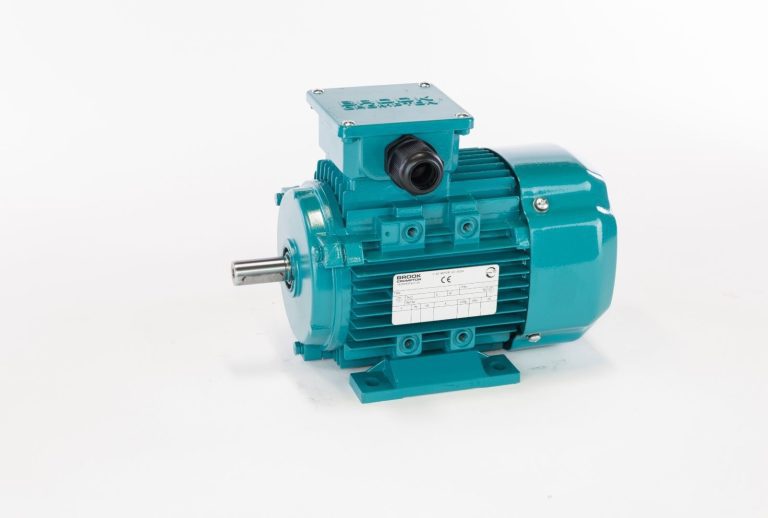
How to Read a Brook Crompton Motor Nameplate

Brook Crompton Motor Nameplate Markings
1. The Frame Reference:
“WP” relates to the series of motor— World Series Premium
“DA” indicates aluminium; conversely, DF would indicate Cast Iron, with the latter being used for high-power applications, and aluminium being used for low-power applications typically offered on 22kW and lower.
“100L” is the motor’s frame size, which will differ depending on the power and speed.
2. The Efficiency of the motor, with the values printed on the line below
For new motors, these will be IE3, IE4, and IE5 due to the new efficiency regulations introduced in 2021.
The higher the number, the more efficient the motor is. This is one of the most important figures as 90–97% of a motor’s total cost of ownership is electricity, with only 2–5% as maintenance & repairs and 1–3% as the purchase cost.
3. The Power Rating in Kilowatts
This figure represents the usable shaft power — not the electrical input.
4. The Voltage when wired in Star(Y)/Delta(Δ)
Star (Y) – Higher voltage, lower current
Delta (Δ) – Lower voltage, higher current
For example:
400V (Y) / 230V (Δ)
5. The Current in relation to the voltage
The nameplate lists the full load current in Amps
This information is vital for:
• Setting overload protection
• Selecting cable sizes
• Verifying performance during testing
6. The Speed/rpm of the motor
Typical speeds at 50Hz:
2 Pole (3000min-1)
4 Pole (1500min-1)
6 Pole (1000min-1)
8 Pole (750min-1)
Note: On non-synchronous motors actual running speed will be slightly lower due to slip.
7. 60Hz Nameplate Data, which is available on request
At 60Hz:
• Speed increases
• Power and current characteristics may change
8. The Phase of the motor (single or 3-phase)
Three-phase motors are most common in industrial applications due to smoother torque and improved efficiency.
9. The Duty Type (S1)
S1 – Continuous duty
S2 – Short-time duty
S3 – Intermittent periodic duty
Continuing to S10 as per IEC 60034-1 (Section 4 of the pdf)
10. Thermal Class (155℃ Class F)
The thermal class defines the maximum permissible winding temperature.
Class F (155°C) is common in industrial motors.
11. Ambient Temperature– The operating environment’s air temperature
Specifies the maximum surrounding air temperature in which the motor can operate safely — typically 40°C unless otherwise stated.
12. Temperature Rise– Increase in equipment temperature above ambient under full load
This indicates how much the motor windings are permitted to rise above ambient temperature under full load.
Example:
40°C ambient
80°C rise
Total winding temperature = 120°C
13. The Degree of Protection relating to the first digit (dust) and second digit (water)
Example:
IP55
5 = Dust protected
5 = Protected against water jets
The higher the number, the greater the protection.
14. The Weight of the motor in KG
15. The Bearing References for the drive end and non-drive end
Drive End (DE)
Non-Drive End (NDE)
This will also indicate if the bearings are insulated, ball, or roller bearings.
16. The Serial Number of the motor
The unique serial number allows traceability of:
• Special features
• Warranty claims
• Spare parts enquiries
Which should always be provided when contacting us or spare part support for direct replacements.
For Brook Crompton motors, click here